



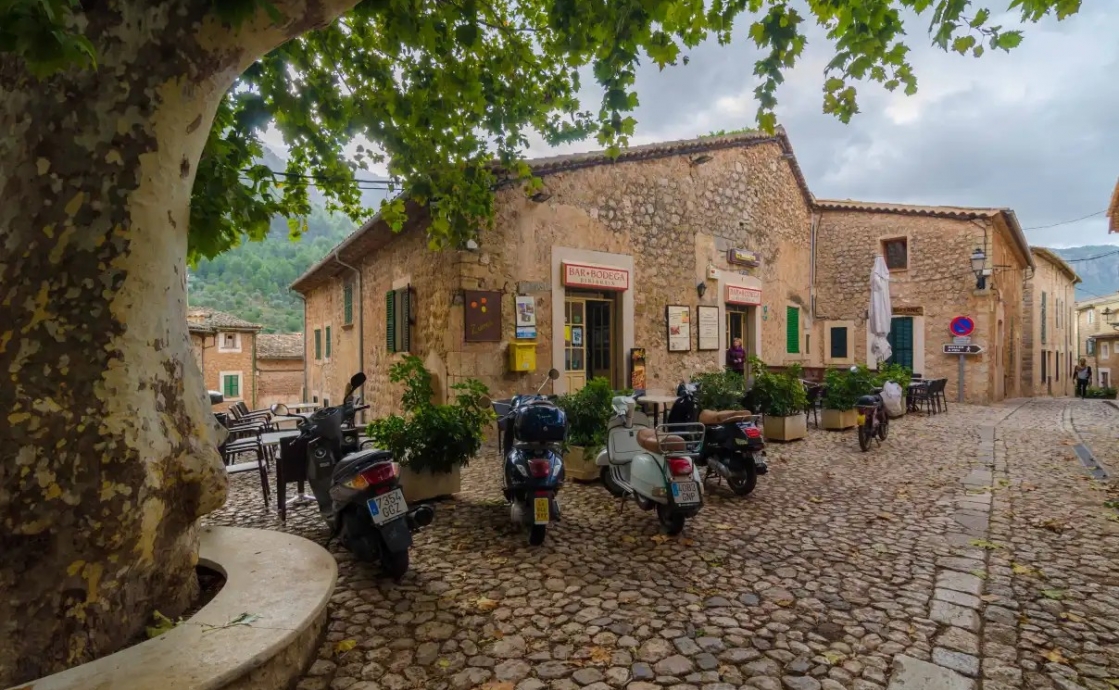
Fornalutx and Biniaraix: The Other Side of the Tramuntana
In Biniaraix, the road ends beside the village wash-house. From there, it's stone all the way: a cobbled path climbing through terraces of centuries-old olive trees into the heart of the Tramuntana. For those who already know the wooden train up to Sóller and the tram down to the port, this corner of the island — just a short drive away — offers a different Mallorca: one of mountain villages and paths that islanders have spent centuries building by hand.
Fornalutx, the village that faces Puig Major
Fornalutx looks down over the Sóller valley from the foothills of Puig Major, Mallorca's highest peak at 1,445 metres. For much of the 19th century it shared a municipality with neighbouring Sóller, before becoming independent; today it has just over 700 inhabitants and a maze of steep, narrow streets that hint at its Moorish origins, with stone houses, orange trees peeking over garden walls, and pots of geraniums on every corner.
Village life revolves around Plaça d'Espanya, home to the town hall in Can Arbona, a former manor house, and the 18th-century parish church. It's worth looking up at the eaves: many houses still carry hand-painted roof tiles, a decorative tradition on display at the Can Xoroi cultural centre. In 1983 Fornalutx received Spain's national award for best-preserved villages, and it now belongs to the association of Spain's Most Beautiful Villages — a title that, strolling its unhurried streets mid-morning, isn't hard to understand.
Biniaraix, the stone gateway
A little over two kilometres away, Biniaraix is barely more than a handful of stone houses around a square, a church and a bar where locals still stop by in the afternoon. There's hardly any tourist trade here: this is where the real journey begins, at the old wash-house marking the edge of the village and the start of the Camí des Barranc — the causeway that, for generations, has been the only way through from the Sóller valley to the highlands of the Tramuntana.
The Barranc de Biniaraix, the Tramuntana written in dry stone
The Barranc de Biniaraix, together with the Camí Vell that continues it, is a protected Site of Cultural Interest. The path once linked the Sóller valley and Fornalutx with L'Ofre, Cúber, Orient and the Lluc monastery, and today it forms part of the GR-221, the Ruta de Pedra en Sec (Dry Stone Route) that runs through the Serra de Tramuntana, a UNESCO World Heritage Site since 2011.
What makes this stretch so remarkable is its craftsmanship: walls, small bridges, irrigation channels and terraces built entirely in dry stone, without mortar — the work of generations of margers, the master dry-stone craftsmen whose trade the Consell de Mallorca revived in 1986 with the founding of the Escola de Margers. The path climbs steadily past centuries-old olive, carob and almond trees, with the sound of the stream close by for most of the year. It isn't suitable for wheelchairs or pushchairs, and good footwear, water and sun protection are essential.
Planning it from Mon Port
From Mon Port Hotel & Spa, Fornalutx and Biniaraix are just over 40 minutes away by car, across the Tramuntana. Spring and autumn are the best seasons for walking the gorge, with mild temperatures and fewer crowds; in high summer, it's best to set off early. Those wanting to combine the outing with the classic route can start the day in Palma, take the historic wooden train and tram up to Sóller, and finish in Fornalutx, a short drive or bus ride from the valley.
Back in Port d'Andratx, after hours of stone, sunshine and steep paths, the spa at Mon Port Hotel & Spa is waiting to round off the day properly.
Fornalutx and Biniaraix don't try to impress at first sight, the way the train or the tram do. They're won over slowly, on foot, among walls that have held up the mountain for centuries. That's their other side of the Tramuntana.