



La Trapa: The Monastery That Became an Environmental Symbol
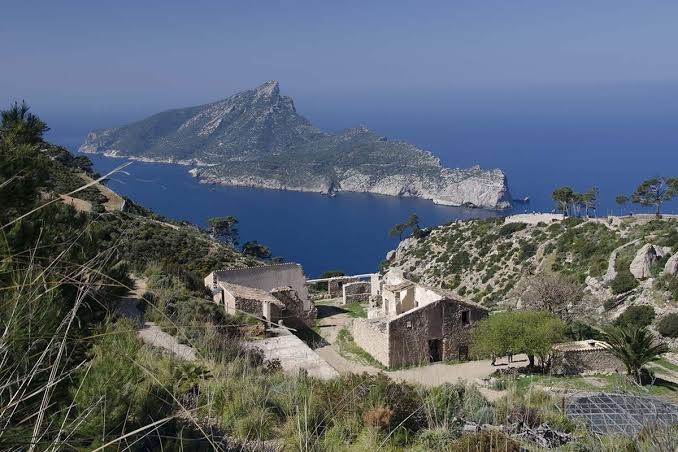
From Sant Elm, the track climbs gently through pine and mastic trees, and the sounds of the village soon fade away. After an hour or so, the path opens onto a valley suspended above the sea. Dry-stone terraces step down towards the cliffs, past a cluster of half-roofed stone houses, a windmill and an old threshing floor. Across the water lies Sa Dragonera, its ridge like the back of a sleeping dragon. Few views in south-west Mallorca explain so clearly why this corner of Andratx has been defended with such determination.
Forty monks in silence
In 1810, a community of Trappist monks fleeing revolutionary France arrived in Mallorca. Canon Pere Roig offered them a property he owned in the valley of Sant Josep, in s'Arracó. The place has carried the name of their order ever since: La Trapa.
Besides their vows of poverty and chastity, the Trappists took a vow of silence. Only one of them, known as the "bread friar", dealt with the outside world, collecting alms. He lived apart from the monastery, in a hut beside the path to the Coll de La Trapa. The rest of the community worked the land. Within a few years they had built terraces and dug channels to capture spring water. In this way they turned an arid hillside into a garden that produced cereals, pulses, vegetables and fruit.
Their stay was short. Part of the community left the island in 1813, and the rest departed for good in 1824. The monastery became a farm and changed hands several times. By the mid-20th century it had been abandoned.
1980: buying a landscape to save it
In the late 1970s, a plan emerged to divide the valley into building plots. The GOB (Grup Balear d'Ornitologia i Defensa de la Naturalesa) responded with something almost unheard of at the time: buying the land to protect it. It founded the association Amics de La Trapa, launched a public fundraising campaign and organised an art auction. It also won the support of organisations such as WWF and the Frankfurt Zoological Society, whose contribution made it possible to complete the payments.
The purchase began in 1980 and was not completed until the early 1990s. The result was more than an 81-hectare estate: it showed that ordinary citizens could take responsibility for a landscape. Today La Trapa is a Natural Site, a Special Protection Area for birds and a Special Area of Conservation. It is also part of the Serra de Tramuntana, a UNESCO World Heritage Site.
Two fires and a reforestation that refuses to give up
La Trapa's recent history is also written in ash. On 1 June 1994, an unauthorised agricultural burn on a neighbouring estate destroyed its entire forest cover. Almost twenty years later, the woodland was beginning to recover when the fire of July 2013 broke out, the worst recorded in the Balearics up to that point. It burned half of the estate.
Since then, the GOB and its volunteers have been working to restore the vegetation, repair the buildings and care for the dry-stone heritage. It is slow, manual work, not unlike that of the monks themselves.
Getting there from Port d'Andratx
The usual starting point is Sant Elm, around twenty minutes by car from Port d'Andratx. Two options leave from Avinguda de La Trapa. The forest track is about 4 km long, easy going, and takes around an hour and a half. The footpath through the pine woods is shorter (1.7 km), but has steep sections and loose ground. For a longer day out, you can also reach La Trapa along the GR-221 from the Coll de Sa Gramola, a walk of about 8 km. All three routes are described on the official La Trapa website.
The estate is privately owned, but access is free and open to all. There is no drinking water or rubbish collection, and mobile coverage is patchy. It is wise to bring water and walking boots, and to take everything you bring back with you. Dogs are welcome on a lead, and camping requires prior permission. The GOB's visitor guidelines ask for something simple: respect the silence. The Andratx tourist office also singles out the viewpoint over Sa Dragonera as an essential stop.
The walk pairs well with the Torre de Cala en Basset, which we covered in our article on coastal walks near Mon Port.
Back to the harbour
After a morning of stone and pine, the return to Mon Port Hotel & Spa has its own rhythm: the pool, the spa and an unhurried dinner. What stays with you is the sense of having seen one of the places where, more than forty years ago, Mallorca decided that not everything was for sale.