



A Day in Galilea: The Village That Looks Down on the Sea
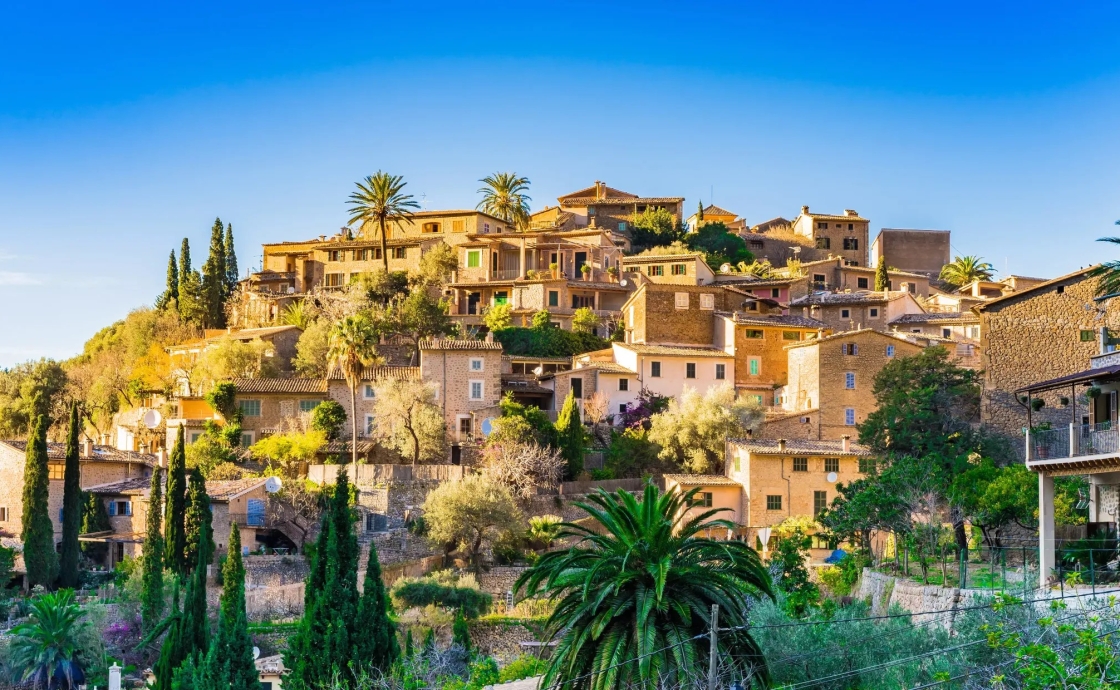
There is a point where the road stops being a coastal road. You leave Port d'Andratx with the sea at your back and, once past Es Capdellà, the tarmac begins to climb between pines and dry-stone walls. Each bend takes away a little more blue, until the sea, which for days has been the backdrop to everything, disappears all at once. The air changes, the sound of the engine changes, the driver's rhythm changes. A few bends further up, Galilea appears: stone houses clinging to a hillside, a church set high above them, and the stillness of a place that is not on the way to anywhere.
A village at the foot of the Galatzó
Galilea belongs to the municipality of Puigpunyent and sits at around 400 metres above sea level, beneath the Puig de Galatzó. It has barely more than three hundred inhabitants. According to tradition, it was named for the resemblance of its landscape to the Holy Land. From Port d'Andratx it is half an hour by car: you climb through Es Capdellà, and the MA-1032 winds up from there to the village.
It is a place without stage scenery. The old buildings still serve everyday life, which is why Galilea can be understood at a glance: what you see is what there is.
The church and its terrace
Everything revolves around the church. Beside it stands a terrace, the best-known viewpoint in the village. On a clear day the view runs across the slopes of the south-west and reaches the sea.
Galilea does not follow a grid: it adapts to the terrain. So there is no need for a route. It is enough to walk slowly through the streets, because behind the walls unexpected views open up and, depending on where you stand, the church shows a different face.
A coffee in the square
Around the square there are a few cafés that exist, above all, for those who come for the view. It is a good place to sit for an hour without looking at the clock. The morning light falls sideways on the stone, and the village still sounds like a village: a door, a conversation, a car passing slowly.
Arriving early is a way of seeing Galilea better. At first light there are few voices, and the square can be crossed from end to end, unhurried. Later come those who climb up to look, and the café fills with different accents. At midday, with the light high, the terrace offers another version of the same landscape. Those who stay do not see the same postcard twice: they watch the day change it.
Two more viewpoints
Very close by are two small stops: ses Timbes and sa Vinya. Neither is a monument. Their charm is the place itself. From them you grasp just how much the Tramuntana shapes the paths and the life of the south-west, beyond the coastal towns. It is worth saving the location before setting out, because in the village streets it is not always obvious.
The next valley: Puigpunyent
If there is time, Puigpunyent is a short hop away. It is a lived-in village of the Tramuntana, not a destination staged for visitors. Around the parish church of l'Assumpció, with its sober lines, daily life, the market and the fiestas still cross paths. Natural stone façades, narrow streets and hillsides within arm's reach: this is what the interior of the south-west looks like when no one dresses it up.
For walkers and cyclists
The surroundings invite walking, and the Puigpunyent area is one that also rewards a bicycle. Those who wish to extend the day can look at the best cycling route through the Serra de Tramuntana or the trekking routes we have already described. And if what you fancy is getting your body ready for the next day, Mon Sports offers an alternative.
Back to the sea
On the way down, the sea returns little by little: first a glint between the trees, then the whole coast. Galilea stays up there, untouched. Back at Mon Port, the spa puts the full stop to a day that began among stone and silence.
More information: Galilea on mallorca.com Puigpunyent on mallorca.com
Destination and Activities Guide