
Castell d'Alaró: The Climb Autumn Deserves
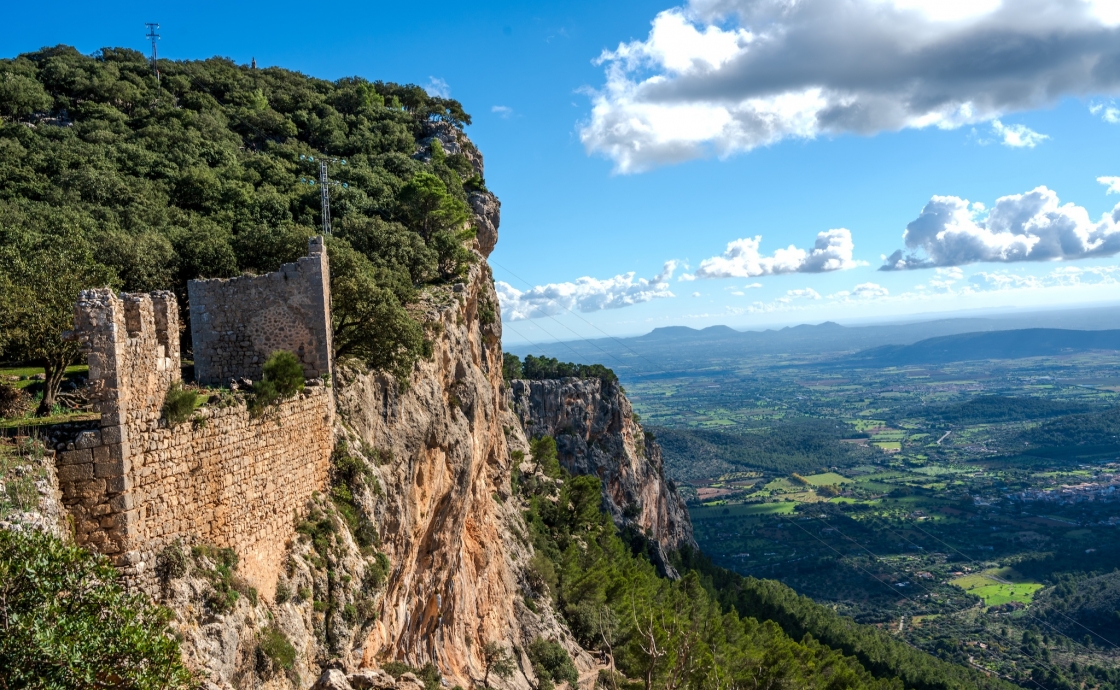
October has a light quite unlike any other. It falls lower and more golden, and leaves the air so clear that the island looks freshly rinsed. It is a light for setting off early, with a flask of coffee in the rucksack and no watch to check. In the interior of Mallorca, at the foot of the Tramuntana, one climb makes the most of it like few others: the ascent to Castell d'Alaró, a ruined fortress at 821 metres, perched on a rock visible from right across the plain.
Trading the sea for the mountains
Anyone spending a few days in Port d'Andratx lives with their eyes on the water. That is why a change of scenery for a morning feels so good. Alaró is a quiet village of stone houses and narrow streets, with a square that wakes slowly among cafés and half-raised shutters. From there, a narrow road climbs between olive terraces to Es Verger, an old possessió where the tarmac ends. The rest of the way is on foot, around 45 to 50 minutes uphill.
Stone, holm oaks and silence
The path soon enters the holm oak woodland. After the first rains it smells of damp earth, and there is shade for almost the whole way. The sound of the car stays below. Up here there is only the crunch of footsteps on stone and the occasional bird. The final stretch is an old cobbled mule track that hugs the rock and passes through an archway beneath the Torre de l'Homenatge, the fortress's only possible entrance.
For those who want more distance, there are two other options. One starts in the village itself and takes just over two hours. The other sets off from Orient and joins the Dry Stone Route (GR 221). It is the same Tramuntana of dry-stone walls and terraces found in Fornalutx and Biniaraix.
A story to tell at the top
Among the walls and cisterns lies one of the island's most retold stories. In 1285, Guillem Cabrit and Guillem Bassa defended the castle against Alfonso III of Aragon and refused to surrender. Tradition holds that they paid for their loyalty at the stake. Mallorca remembers them as martyrs, and their figures still appear on the altarpiece of the small oratory crowning the summit.
Coffee, pa amb oli and half the island at your feet
The Oratori de la Mare de Déu del Refugi was built in 1622. Beside it stands the hostatgeria, a simple mountain refuge where a coffee or a pa amb oli tastes different after the climb. The almond cake has its loyal followers. Some stay the night just to see the sky once darkness falls.
From the edge of the plateau, the view sweeps across the peaks of the Tramuntana, reaches the Bay of Alcúdia and drops towards the Pla, chequered with almond groves and villages. In the October air, the horizon has a sharpness that summer rarely allows. The Alaró guide on mallorca.com rounds off the day with what the village has to offer.
The afternoon, back by the sea
The descent feels light. At Es Verger, mountain cooking is almost a tradition for ending the outing. Then the road leads back to the coast.
In Port d'Andratx, the afternoon calls for warm water and calm. The Mon Port spa is the best place for tired legs to remember the climb without complaint. For other days, Mon Sports brings together more outdoor plans. La Trapa offers another walk steeped in history, much closer to Mon Port Hotel & Spa.