
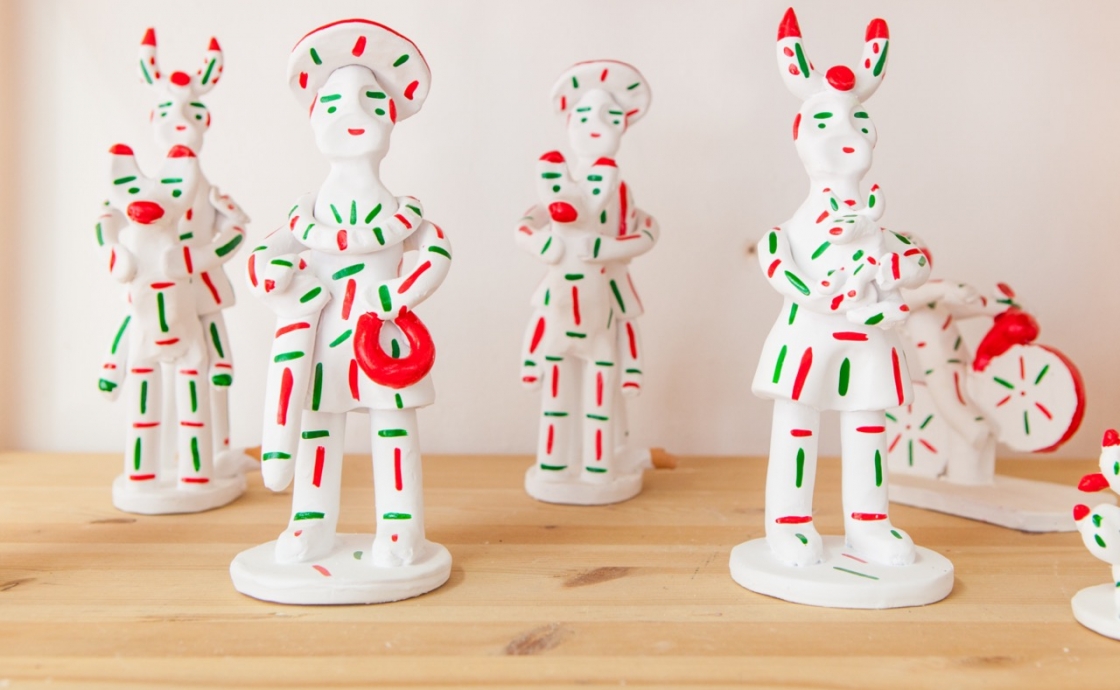
Siurells: The Clay Whistles Painted in Three Colours
On a wooden table in a workshop in Sa Cabaneta, dozens of small white figures sit drying in rows: a pagès in a hat, a horseman, a bull with oversized horns, a dimoni with outstretched arms. None is bigger than a hand. The siurellera dips a fine brush in red paint and draws three quick strokes without hesitating, the way someone signs their name. Then she moves on to green. When she has finished, she raises the figure to her lips and blows into the base. Out comes a high, clear whistle, almost like a bird's.
That is a siurell.
A toy that sings
The name says it all: siurell comes from siular, the Mallorcan word for "to whistle". Every figure hides a whistle in its base, and that whistle is the whole point of the piece. For generations it was a children's toy, bought at village fairs and eventually broken from so much blowing.
The figures fall into three families: human, animal and mixed, like the horseman on his horse. Each one is shaped by hand, so no two are alike. Traditionally the craft belonged to women and was passed down from grandmothers to mothers and from mothers to daughters.
White, red and green
Fresh from the kiln, a siurell has the brownish colour of fired clay. What makes it recognisable comes later. A dip in lime turns it white, and on that background go long brushstrokes of colour. The most common pairing is red and green. Yellow or blue sometimes appear, almost always alongside red.
The decoration doesn't imitate anything. There are no painted eyes and no buttons on the jacket, just stripes and dots that follow the shape of the figure. That simplicity explains why a village toy now looks like a piece of design.
An origin nobody has settled
Asking where siurells come from opens a long conversation. Theories follow one another: the Phoenicians, an ancient Arab toy, a kinship with figures found in Crete or Sardinia. Some historians place their arrival on the island much later, in the 19th century. Nobody has settled the question.
There is also an old folk belief that their whistle kept evil spirits away. Either way, the siurell doesn't need certainties. It makes sense the moment you hold one.
Marratxí, terra de fang
The heart of the craft lies in Marratxí, and more precisely in Sa Cabaneta and Pòrtol. Pottery in these two villages goes back centuries, and several olleries, the traditional pottery workshops, stay open all year round. It is no accident that the municipality is known as terra de fang, the land of clay.
In Sa Cabaneta, a former grain windmill from the early 19th century houses the Museu del Fang, which opened as a museum in 2002. Its collection covers the island's everyday ceramics, including water jugs, roof tiles and cooking pots. It also has a space of its own for siurelleria, with workshops for children and adults on special days.
Every March, the Fira del Fang brings together potters and siurellers from Marratxí and beyond for around ten days, with workshops, music and parades of dimonis. Like the Festa des Vermar in Binissalem, it is a celebration that has kept its original purpose: honouring a craft that is still alive.
Miró and a child's eye
Joan Miró collected siurells. He kept them in his Mallorca studio alongside stones, roots, shells and nativity figurines, and he looked at them with the attention others give to a painting. You can see their mark in his work: flat colours, simple shapes and a good dose of humour.
In the early 1970s, Miró even designed a monumental sculpture for Central Park in New York, and its polychrome model is directly reminiscent of a siurell. It was never built. In 2025 the Fundació Miró Mallorca devoted an exhibition to the story of the project.
A siurell in your suitcase
From Mon Port, Marratxí is a little under an hour's drive away. The visit fits into a morning: the museum, a couple of workshops and a coffee in the square. If the day allows for more, the Castell d'Alaró is just a few kilometres further on, at the foot of the Serra.
Back in Port d'Andratx, with the afternoon light falling on the quay, a siurell in your pocket weighs very little. It will last far longer than any souvenir bought in a hurry.