



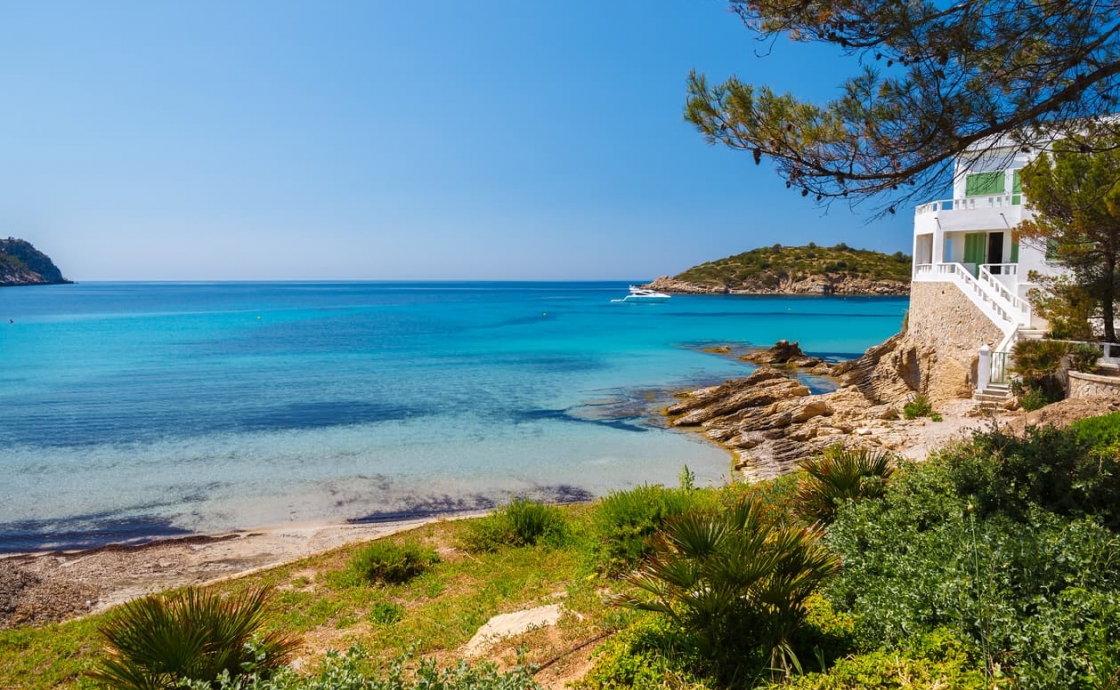
Mallorca's Other Beaches: Southern and Eastern Coves Worth Exploring
Port d'Andratx already has a character all of its own: the sheltered sea, the pines that reach right down to the shore, the light that shifts with every hour of the afternoon. But Mallorca is an island of short distances and landscapes that transform completely within a couple of hours' drive. Anyone staying in the south-west who feels curious about "the other island" — the one of hidden coves tucked between pine woods, salt lagoons and cliffs that open up all at once — will find that the south and east coasts are worth at least a day of discovery.
The South: Salt, Dunes and Water That Looks Caribbean
The area around Campos and Santanyí holds some of Mallorca's most photographed spots — deservedly so. Es Trenc lies within the Es Trenc-Salobrar de Campos Nature Park, a protected Area of Special Natural Interest where the beach sits alongside salt ponds, dunes and lagoons that draw flamingos and ospreys. The contrast between the almost-white sand and the green of the surrounding pines explains why so many visitors compare it to the Caribbean, even though the landscape here carries centuries of salt-making history behind it.
A little further east, in the municipality of Santanyí, the Mondragó Nature Park has protected more than 700 hectares of pine and wild olive woodland, low cliffs and two coves worth knowing apart since 1992: Cala Mondragó, more accessible and family-friendly, and S'Amarador, almost untouched, with no buildings in sight and a small freshwater lagoon just steps from the shore.
And when it comes to small coves, few match Caló des Moro: barely thirty metres of sand and shingle between two pale rock walls, clear water and a walk-in access that calls for sturdy legs and proper footwear. This isn't a spot for a full day with a parasol and a cool box; it's a stop for a swim, a long look at the colour of the water, and moving on.
The East: Pine Woods, Dunes and Villages Named After Streams
Crossing the island towards Capdepera, the landscape shifts register: the stone turns paler, the pine woods thicken and the coves open up between low cliffs. Cala Agulla is the best known spot in the area, with over 500 metres of white sand backed by dunes and a pine wood that has kept much of its original character — a rare thing on a coastline that has, elsewhere, been built up with ease.
Close by, Canyamel beach offers another scene typical of this stretch of coast: a stream mouth cutting through the sand to meet the sea, with the Coves d'Artà nearby as the perfect excuse to extend the trip further inland.
Planning the Trip
The south and east of Mallorca can't be covered in one afternoon: Port d'Andratx and Capdepera are well over an hour apart by car, and the roads skirting the villages of the Llevant and Migjorn regions invite more stops than planned. Those who'd rather leave the car behind can consider sailing out from the harbour itself and deciding along the way whether the day's cove-hopping is better done by land or by sea. And if the weather doesn't cooperate, this route can always wait for a clear-skied day, with the indoor plan B kept in reserve for windy ones.
Whichever route is chosen, coming back to Port d'Andratx afterwards has its own pleasure: the calm of the harbour, dinner looking out over the water, and the certainty of having seen, in a single trip, the many faces of one island.